TheGymFaction
Ready to Transform? Scan to Get the FREE App!
Personalized Workouts, Diet Plans, and Wellness Tracking at Your Fingertips


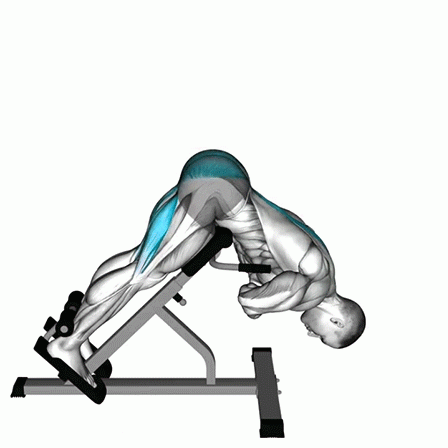
45-Degree Hyperextension: Strengthen Your Lower Back
The 45-degree hyperextension is a powerful posterior chain exercise that targets your glutes, hamstrings, and lower back (erector spinae). By using the hyperextension bench set at a 45-degree angle, you can train hip extension safely while improving posture, spinal health, and overall strength. This exercise can be tailored to emphasize either the glutes or spinal erectors, depending on your training goals.
Instructions
Setup
-
Position yourself in a hyperextension machine with your feet firmly anchored.
-
Your torso should be roughly perpendicular to your legs at a 45-degree angle.
-
Hold a weight plate against your chest with arms crossed or keep your hands at your sides if using bodyweight only.
Execution
-
Starting Position
-
Begin in a hinged position with your torso lowered.
-
Keep your back straight, core braced, and chin tucked.
-
-
Lifting Phase
-
Initiate the movement by engaging your glutes and extending your hips.
-
Raise your torso until your body forms a straight line from head to heels.
-
-
Contraction
-
Pause briefly at the top, focusing on glute or erector activation depending on your goal.
-
-
Lowering Phase
-
Slowly return to the hinged position under control without rounding the spine.
-
-
Repetition
-
Perform for the desired number of reps and sets based on your program.
-
Training Focus: Two Variations
-
Glute-Centric Hyperextension
-
Slightly flex your upper back.
-
Extend your hips only until your body is straight.
-
Emphasize glute contraction throughout the movement.
-
-
Erector-Centric Hyperextension
-
Arch your spine globally.
-
Focus on activating the erector spinae muscles for spinal strength and endurance.
-
Tips for Proper Form
-
If you struggle to feel glute activation, palpate your glutes with your hands and pause at peak contraction.
-
If one glute contracts less efficiently, use unilateral variations (single-leg hyperextensions) and perform extra volume on the weaker side until balanced.
-
Avoid excessive arching or swinging—keep the movement slow and controlled.
-
Maintain a neutral neck; don’t crane your head forward.
-
Start with bodyweight only before progressing to weighted variations.
Benefits of the 45-Degree Hyperextension
-
Builds stronger glutes and improves hip extension power.
-
Strengthens the erector spinae for spinal stability and posture support.
-
Enhances hamstring activation and posterior chain balance.
-
Reduces the risk of lower back pain when performed correctly.
-
Improves performance in deadlifts, squats, and athletic movements.
-
Can be customized for glute isolation or spinal endurance training.
Conclusion: The 45-degree hyperextension is more than just a lower back exercise—it’s a complete posterior chain builder. Whether you focus on glutes or erectors, mastering this movement will improve strength, stability, and injury resilience.
Related Posts
Smash Your Goals 🚀
Smart Workout Power Calculator
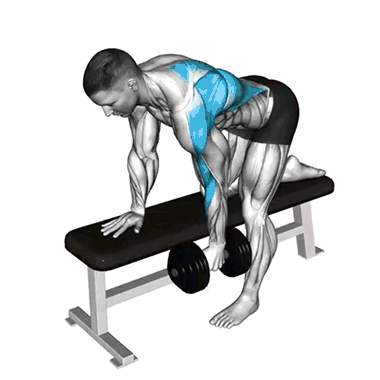
One Arm Bent-Over Row: Strengthen Your Back and Arms
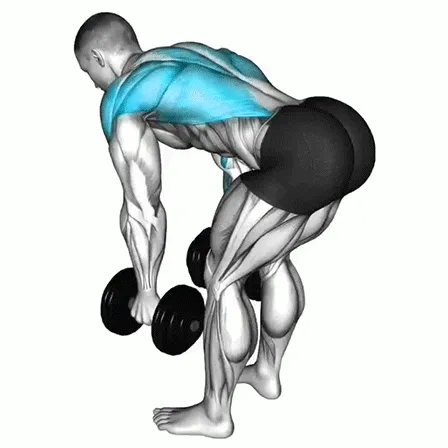
Dumbbell Bent-Over Row: A Guide to Back Workouts
Dumbbell Pullover: Perfect Chest and Lats Exercise
Barbell Bent-Over Row: Build Back Strength
Barbell Romanian Deadlift: Strengthen Your Hamstrings